Insights by Danielle Fong

a wick for ideas

Month: January, 2008

Incompleteness and Halting. Gödel and Turing.

The following occurred to me on a run about two years ago:

It’s not given much press, but the the Halting Problem is intimately related to Gödel’s First Incompleteness Theorem. Indeed it produces it as a correllary. Historically, Gödel’s incompleteness results were proved by hacking arithmetic into a Turing complete system, and this is still how they’re explained today.

There’s a one-to-one bijection between computability of a function and provability of a statement. Hence, the short, and generally accessible proof that the Halting problem is not in general computable for an arbitrary input is also a proof of the ‘most important, surprising result in logic’, namely, that some results, which have may have a perfectly valid truth-value outside a system, cannot be proven within it. One only needs the notion of a computer to follow this line of thinking, which is, in essence, what Gödel did. But the Halting problem is much easier to grasp. I’ve had children understand it, though it does take some walking through!

The interesting thing about the Halting problem is that it’s unsolvable in full generality, independent of whatever special capabilities the system has available. To see this clearly, consider the proof.

Question: Does there exist a (halting) program H which, given any program P, figure out if it would halt, for any input I?

Assume there exists such a program H. Construct a program T as follows.

(Program P, Input I) => (Boolean Halts):
if H(P,I) is true run forever
otherwise halt

Now, call T on itself, with itself as an input. Our assumption presupposes that H always halts. If T would halt on input T, then T will run forever. And if T would run forever on input T, then T would halt. This is a contradiction, so no such program H would exist.
Read the rest of this entry »

On Outliers: What they represent, and why the Central Limit Theorem is Typically Off.

A Bell Curve

The central limit theorem states that if you have many small, independent, random variables, then their sum is distributed approximately as a bell curve. Strikingly, almost everything is made up of many small parts, and these parts don’t tend to influence each other very much.

So much of what can measure seems to fit a bell curve. This is why the normal distribution works. Because this assumption tends to work well, it is usually taken as a matter of course. Students are taught it, lecturers preach it, researchers apply it, and startlingly few stop to question it.

Suppose the variables are not small, or suppose they’re not independent. Suppose, under certain conditions, the value of one variable would seriously effect another. Suppose we’re talking about the buildup of snow on a mountain slope. Most of the time, snowflakes can gradually build, without significant effect. But once enough builds, you don’t find snowflakes resting calmly upon a drift. What you find is an avalanche.

Violent nonlinearities...

The sum total of snowflake movement isn’t what we might expect. The snowflakes on the top used to be lightly packed by the new, gradually coming down. The snowflakes on the bottom used to just sit there. But they’re not just sitting there. They’re moving fast, and they’re moving down.

Read the rest of this entry »

General Problem Solving Strategies (for programmers)

Konstantin Lopyrev writes (on the TopCoder forums):

“Everyone always discusses algorithms and such on this forum. However, there is one trait that is perhaps equally important as knowledge of algorithms – good problem solving strategy. By that I mean not jumping into solutions too quickly, thinking through everything before writing any code and such. Can anyone share what they’ve figured out that helps them? I’ve noticed that I have several flaws when I solve problems in general. I am too quick to start writing code. Also, I don’t think through my algorithms thoroughly. Also, there are many other things. Does anyone have similar flaws that they’ve already passed. If you have, please share your strategies for getting better at problem solving in general. Anything would be helpful, since I have the TCHS tournament coming up and I want to go home with some sort of prize.”

I wrote back, on May 10th ’07:

One thing I want to start doing is to make estimates of the implementation time of parts of my solution, how difficult each will be to code correctly/debug, and how sure I am that my method will work in the first place.

I’ve gotten very good at making estimates of time and space constraints. Now they are second nature. But knowing how best to solve a problem practically is still another area which I need to improve.

For example, for the last hard problem on TopCoder (circa May 9th, sorry, you’ll have to register to see it). I broke the problem down. Six steps toward victory! Five of those steps were really quite simple, though a few bugs crept in. The sixth was brutal — I could solve the problem by implementing a complicated comparison function object which recursively called itself on sorted sets of children. It was really crazy. To get it all working properly took nearly eight hours after the match.

Each bug, if not isolated, tends to increase debugging time by something like the square of the number of interacting components: the rate at which the number of dependencies would grow. Perhaps it would be simpler to either independently verify each component (by having pre-written tested functions or methods), or to organize the program, inasmuch as possible, as a linear pipeline or other simple acyclic graph. In fact, one might take a few seconds just to sketch the program idea out — how strongly coupled is it? What can I be sure of? How much of a pain will it be to debug? Can I make it less so? If not, can I anticipate debugging requirements and build in information gathering tools?

Read the rest of this entry »

Quantum Field… Finance?

One morning around the graduate college dining hall, there was a gathering of physicists, finance students, and economists. The physicists are always quite amazed by those people who decide to forgo the life of the ivory tower, and choose to strike out into the real world, and so could not be kept from asking what the economists actually did. Furthermore, we could not be kept from wondering aloud what type of mathematical models they built and polished, and whether any of them had a physical interpretation.

One of the economists scratched his head, drew a sip of black coffee from his porcelain cup, and mumbled something about how a large proportion of the physics department of Harvard University was hired by a trading company, with the lure of riches beyond the pale of the meager imaginings of the physicists (“you mean I can afford a house?!”).

Read the rest of this entry »

Third Places

Caffe Strada

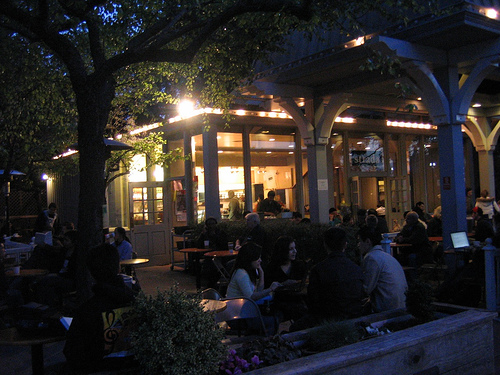
Tonight it’s winter in Berkeley. 53 degrees and raining, and outdoors, warmed by a heat-lamp, sheltered by an awning. I draw spiced apple cider through my lips. Classical music plays. An earbudded minority vote silently with their ears. Old men watch hooded students roll down the hills towards Telegraph Ave, Berkeley’s epicenter of hippiedom. Moist, newspapers ink the hands of activists, busily plotting the victories in the years long struggle to ‘save the oaks’. A young man lids a drink and smiles at me. Separated by glass, headphones, and 12 feet, I smile back. We wave.

There’s something magical about this place.

I don’t know anyone here. To arrive I flew four thousand miles from my place of growth. This place isn’t home. Yet there are few places that attract me so strongly. Modern life has been made private. And in doing so, life’s become a little lonely.

Builders of great cities have long understood that life would, but for misfortune, consist of more than work and one’s home. The vibrancy, energy, and community grown in what are sometimes called ‘third places’ played part in much of the world’s social, political and intellectual revolutions. The roles that the Roman forae, French salons, and English learned societies played in scholarship has been tremendous, as has been the influence of American chautauquas, worker’s taverns, and artist’s ghettos in social and political spheres. These public, accessible, talkative, comfortable playful places are magnets for folks of many stripes. Creativity can thrive there. Unconstrained by work’s implied unity of purpose, and decoupled from the tight bonds around one’s family and home, third places give marginal people, ideas, and voices room to grow, people to hear them, perspectives to challenge them, and food to help keep the conversation going.

Read the rest of this entry »

Follow

Get every new post delivered to your Inbox.

Join 57 other followers